
Team Building Activities in Sacramento: A Practical 2026 Guide
Most team building feels like homework. The workshop facilitator asks everyone to share their communication style, someone makes a forced analogy to the business, and everyone goes back to their desks having spent four hours they will never get back. That kind of event does not build culture. It just checks a box.
The events that actually build team culture are ones where people are voluntarily engaged. Not because they were told to be, but because what is happening in front of them is genuinely interesting, funny, or challenging. The best company outing your team will remember in five years probably did not happen in a conference room.
This guide covers the most common team building options available in the Sacramento region, with an honest take on what each one delivers and who it works best for.
What Makes Team Building Actually Work
Before comparing specific venues and activities, it helps to understand what the research and practical experience both point to. The events that generate lasting team cohesion tend to share four characteristics:
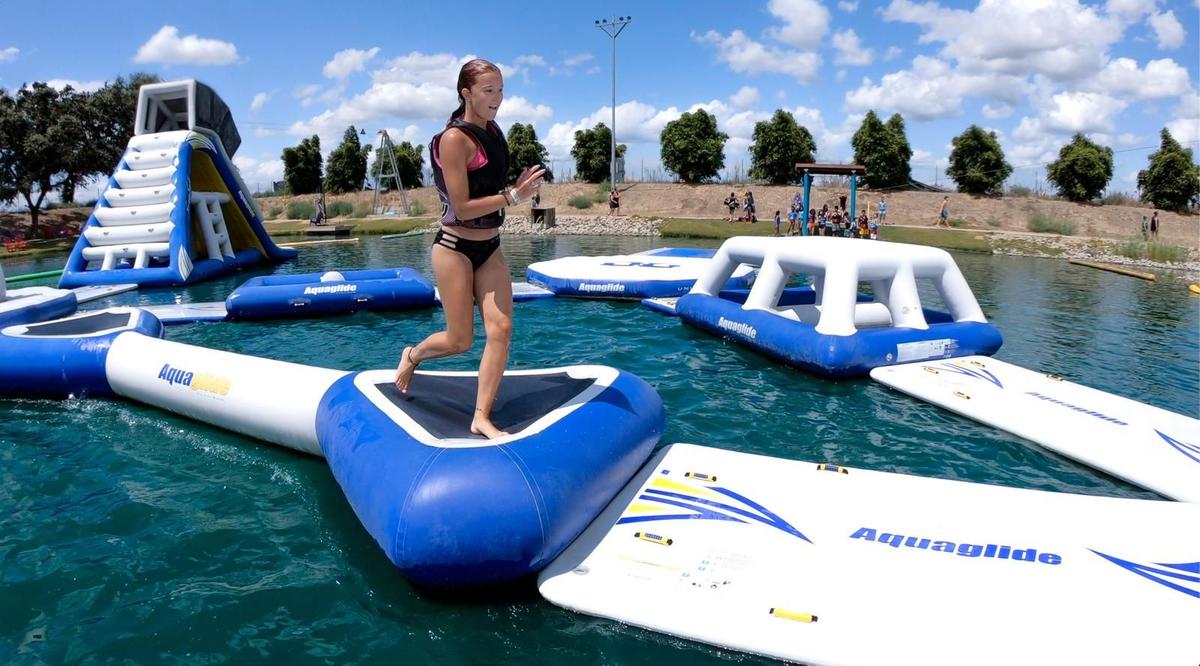
A shared challenge that has nothing to do with work. When the challenge is work-related, hierarchy reasserts itself. The senior employees lead, the junior employees defer, and nothing changes. A challenge that is outside everyone's area of expertise (like navigating a floating obstacle course) levels the playing field. Everyone is equally uncertain. That shared vulnerability is where connection happens.
Physical activity that is approachable for most fitness levels. You do not want an activity that excludes half the team because it requires a specific skill set or fitness level. The best activities have an easy entry point and a natural progression for those who want more challenge. Someone who has never wakeboarded and someone who rides regularly can both participate at Velocity Island Park, just at different skill levels and activities.
Time for informal conversation, not just structured activities. The most important connections happen between activities, not during them. A venue that includes food, a place to sit, and unscheduled time gives people space to talk. An itinerary packed wall-to-wall with structured games actually undermines this.
Something to talk about afterward. The stories that come out of a team event are part of the value. "Did you see when Marcus fell off the aqua park?" is the kind of shared reference point that becomes part of a team's identity. Activities that are forgettable do not generate those moments.
Common Sacramento Team Building Options: An Honest Assessment
Here is how the most common options in the region stack up against those criteria.
Escape rooms are genuinely good for what they do: they require communication and collaborative problem-solving in a time-limited environment, and they scale well for small groups. The ceiling is about 8 to 10 people per room, which is the first problem for teams larger than that. You either split the group (which means different experiences and no shared story) or you book multiple rooms (which multiplies the cost fast). There is also no food, no outdoor component, and no downtime for informal conversation. For a team of 8 or fewer who values puzzle-solving, escape rooms are a solid choice. For groups larger than that, the format breaks down.
Axe throwing venues are an easy logistics win. Most venues in Sacramento can accommodate mid-size groups (20 to 40 people), and the activity is approachable for nearly everyone. The honest limitation is longevity: most people have had their fill of axe throwing within 90 minutes to two hours. It works well as a happy hour add-on, but it does not fill an afternoon or build the kind of shared experience that a full-day event creates. The novelty wears off faster than most people expect.
Cooking classes are excellent for bonding over a shared task, and they have a built-in ending (you eat what you made). They tend to work well for teams that already communicate well and want a low-intensity social experience. The downsides: they are expensive per person, they create friction for people with significant dietary restrictions, and they can be uncomfortable for introverts who are not natural conversationalists in a forced proximity setting. They also require a venue that can accommodate your group, which can be hard to find for groups over 20 to 25.
Bowling alleys and sports bars have the lowest friction of any option, and that is both their strength and their weakness. Nearly everyone is willing to go. There is no commitment required, and there are TV screens and food to fall back on if conversation dries up. The problem is that these conditions also mean people end up in their existing cliques. The people who already talk at work will talk at a bowling alley. The people who do not will watch the game. If the goal is to create new connections or reset team dynamics, a bowling alley rarely delivers.
Ropes courses and outdoor adventure parks check the shared physical challenge box well. Activities like zip lines, high ropes, and team obstacle courses require genuine mutual support and produce the kind of shared stories that last. The practical issues: most ropes course facilities in Northern California are 30 to 45 minutes from Sacramento, limiting the viable attendance pool. Food options are usually limited to a snack bar or bringing your own. Per-person costs are often high relative to what you get. They work well for small teams willing to plan around the logistics.
Water parks and outdoor recreation venues tend to perform best for larger groups (20 to 200 or more) because they offer a combination of structured and unstructured time, multiple activity options for different comfort levels, on-site food and drinks, and enough physical space that people can mix and mingle naturally. The stories they generate (falling off the aqua park, finally getting up on a wakeboard, watching a coworker attempt paddleboarding for the first time) tend to be ones people tell for years.
Why a Day at Velocity Island Park Works for Corporate Groups
Velocity Island Park is located in Woodland, California, about 20 minutes north of Sacramento on I-5. It is not a traditional theme park. It is a 15-acre lakefront property with a cable wakeboard system, a floating obstacle course (the aqua park), a swim beach, paddle boarding, a restaurant, and private event spaces. That combination matters for corporate groups for a few specific reasons.
First, there are activities for every comfort level. Not everyone on a corporate team is going to be willing to strap into a wakeboard. But almost everyone can walk the beach, float on a paddleboard, or attempt the aqua park. Nobody gets left out, and nobody feels pressured to do something they are genuinely not comfortable with.
Second, the aqua park obstacle course creates natural team moments without requiring a facilitator. Certain sections of the course are genuinely easier to navigate if someone helps you across. That kind of organic cooperation, where a person you barely know reaches out a hand to help you not fall into a lake, does more for team cohesion than any structured icebreaker.
Third, private beach sites give the group a home base. Instead of wandering a venue looking for your colleagues, everyone knows where to return. You can set up food, leave your bags, and have a central gathering point that makes the day feel organized even when most of it is unstructured.
Costa Fuego, the on-site restaurant, can handle group catering with wood-fired pizza, drinks, and lakefront seating. You do not need to coordinate outside catering or leave the property for lunch.
The drive from Sacramento is easy: straight up I-5 North to Exit 536. Most employees in Sacramento can get there in under 25 minutes. That matters for attendance. The further the venue, the more people find reasons not to come.
Group rates are available for 20 or more people. Contact the events team for a custom quote based on your group size and preferred activities.
Planning a Team Outing at the Park
A few things that make a difference in how the day goes:
Book early. Summer weekends fill up, particularly Saturdays in July and August. If you have a target date, get it on the calendar as soon as possible. Group bookings through the groups page or the contact form are handled directly by the events team.
Think about half-day versus full day. A half-day (arriving around 10 AM, leaving by 2 PM before the afternoon heat peaks) works well for groups that want a clean, contained event. A full day works better if you want to include a beach bonfire in the evening or add a seated dinner at Costa Fuego.
Build a simple structure, then leave room. A suggested flow: start with the aqua park in the morning when the group has the most energy. Mid-day, open it up so people can choose their own activity. Offer wakeboard beginner lessons as a voluntary option. Wind down with lunch or a late afternoon beach bonfire. That structure gives people a shared experience at the start and end while leaving the middle open for the conversations that matter.
Send waivers ahead of time. All participants in water activities need a signed waiver. Sending the link before the event day (rather than handling it at check-in) keeps the morning running smoothly. Under 18? A parent or guardian must sign.
Consider a meal package. Asking everyone to figure out their own lunch at a corporate event is a missed opportunity. A group lunch at Costa Fuego, even a simple pizza-and-drinks setup at the beach sites, keeps the group together and extends the informal conversation time that is where most of the real team building actually happens.
For groups with specific requirements, including private event space, custom catering, or structured activities led by park staff, the events team can build a custom package. Contact us through the corporate events page or reach out directly via the contact form.
The goal is a day that people actually talk about afterward, not one they sit through politely and forget by Thursday.